
April 2026
Market Commentary
April is Not the Cruelest Month
With all apologies to T.S. Eliot, April was a strong month for U.S. stock market investors, with the S&P 500 increasing by

10.4% and the Nasdaq by 15.3%. Given these results, one might expect improving geopolitical conditions. Instead, tensions remained elevated.
The Strait of Hormuz, responsible for 20% of global oil flows, remains largely constrained, and oil prices climbed, closing out the month at $105 a barrel.
So why has the US stock market remained resilient in the face of ongoing geopolitical uncertainty?
Earnings are Driving the Rally
The answer lies with the most important determinant of future stock prices – corporate earnings. These earnings are fueled by a robust and growing economy and propelled by ever increasing investments in artificial intelligence (AI). Coming into 2026, earnings were expected to grow by about 14% for the year, following 11.5% growth in 2025. Now, with many companies having reported strong Q1 2026 earnings, analysts have raised full year guidance to 18.6% growth for 2026. This earnings growth comes from a strengthening economy, with Real GDP growing at 2% for the first quarter, a marked improvement from 4th quarter 2025 growth of 0.5%.
Emerging Headwinds: Inflation and Rates
One might think that this rocket ship of corporate earnings was headed into clear and sunny skies, but other economic developments point to possible volatile weather ahead. Foremost would be inflation, which came in through March running at an annual rate of 3.3%, still far above the Federal Reserve’s long-term target of 2%. Higher oil prices are also beginning to affect consumers, with gasoline now averaging $4.30/gallon, up about 8% for the month of April. Because oil is used in the manufacturing of countless products, rising energy costs can push up prices across a wide range of goods, including
cosmetics, clothing, electronics and plastics.
Higher sustained inflation has caused the Federal Reserve to pause on their easing campaign, and the market now forecasts no further interest rate cuts in 2026. Indeed, April saw interest rates climb, with the 5-year Treasury rate going from 3.92% to 4.02%. Finally, while 2nd quarter GDP was strong, there was a slowdown in consumer spending. Higher inflation and interest rates could lead to an even more constrained consumer, eventually translating into reduced economic activity and lower earnings.
AI Investment Continue to Power Growth
For now, all these potential negative forces are being offset by AI and the sheer size of the spending to build out this technology. The chart below shows the extent of the 2026 spending by what are known as the hyperscalers, and how increasing inflation has caused these initial projections to rise. $800 billion is projected to be spent this year, with an even higher amount in 2027, and this investment has acted as a shock wave through the U.S. economy, raising demand for energy, semiconductors, building supplies and materials.
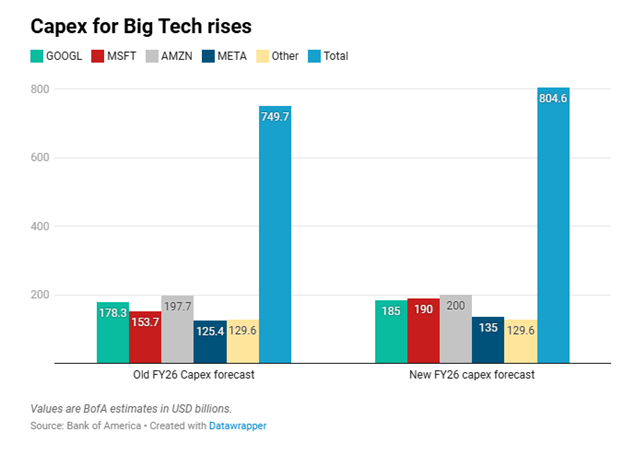
To put this in perspective, $800 billion in one year is almost three times the total cost of the Apollo space program (in today’s dollars), which spanned 13 years1. For now, the stock market is successfully riding the investment and promise of AI, but if the story falters, or the technology underdelivers, market volatility could increase.
Periods like this highlight a familiar challenge for investors: balancing opportunity with uncertainty during a major technological shift.
Staying Disciplined in a Changing Market
Our approach remains consistent – diversification, prudent risk management, and a long-term view. At Cape Cod 5, our team applies these principles in our construction and oversight of client portfolios. If you have any questions or would like to speak with your team of advisors, we encourage you to reach out.
________________________________________________
1https://www.planetary.org/space-policy/cost-of-apollo#:~:text=The%20United%20States%20spent%20%2425.8,billion%20(%24338%20billion%20adjusted)
These facts and opinions are provided by the Cape Cod 5 Trust and Asset Management Department. The information presented has been compiled from sources believed to be reliable and accurate, but we do not warrant its accuracy or completeness and will not be liable for any loss or damage caused by reliance thereon. Investments are NOT A DEPOSIT, NOT FDIC INSURED, NOT INSURED BY ANY FEDERAL GOVERNMENT AGENCY, NOT GUARANTEED BY THE FINANCIAL INSTITUTION AND MAY GO DOWN IN VALUE.
