
July 2026
Market Commentary
Rates, Results, and Rotation
July 2026 market performance was driven by two significant events: the July 28-29 meeting of the Federal Reserve and the second quarter earnings releases from the largest information technology companies. Macroeconomic forces – the Fed and interest rates – collided with microeconomic developments – tech sector earnings – in late July, resulting in a spike in volatility to close out the month.
Federal Reserve Takes Center Stage
Investors were closely watching the July Federal Open Market Committee’s rate decision and subsequent commentary from new Chair Kevin Warsh. In a hawkish stance, the Fed left the federal funds rate unchanged, acknowledging the risks to the economy posed by persistent inflation. This represented a shift from the dovish expectations of a few months ago. Markets are now cautiously contemplating potential future rate increases, as June inflation data showed a moderate slowdown but remained stubbornly above the Fed’s target.
Corporate Earnings Compete for Spotlight
The last week of July was chock full of corporate earnings releases. The most watched were the mega-cap technology giants. Investors carefully scrutinized each company’s artificial intelligence spending, return on prior investments, and the durability of earnings as reflected in their guidance and analyst calls.
Investors rewarded Microsoft and Amazon, whose results provided a concrete connection between prior capital investment and current revenue growth. By contrast, Alphabet and Meta, which each raised their capital expenditure plans for 2026 at the expense of operating cash flow and margins, were met with less favorable investor reactions.
Rotation Receives Top Billing
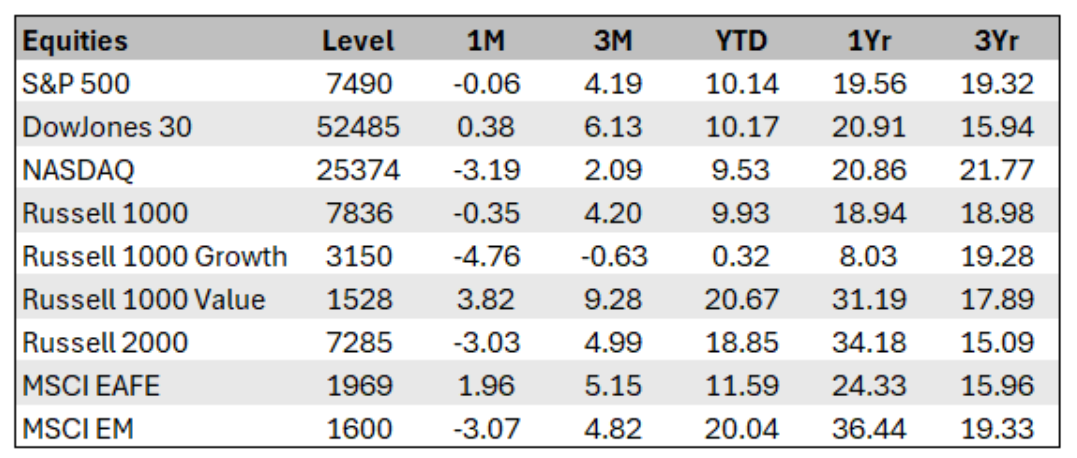
The dichotomy of sector-specific returns for the month can be observed by looking at the monthly performance of three different indices, all well-regarded bellwethers.
The S&P 500 index, the flagship benchmark for large-cap U.S. stocks, declined 0.06% in July, as investors sold out of the mega-cap tech and growth stocks that had dominated returns earlier this year and rotated into defensive and cyclical industries.
The Dow Jones Industrial Average, a blue-chip manufacturing-heavy benchmark, rose 0.38%, driven by gains in non-technology sectors.
The Nasdaq composite, a tech-heavy benchmark, declined 3.19% as investors took profits in AI and AI-adjacent firms, including semiconductors, amid valuation concerns.
Source: FactSet
Whether July’s move out of technology and into other sectors was a temporary blip or the start of a broader trend remains to be seen.
As we move further into the second half of the year, geopolitical developments, inflation trends, the midterm elections, and potential Fed policy adjustments will join corporate earnings in driving investor sentiment and market returns.
Your Cape Cod 5 team is always here to help. Please don’t hesitate to reach out with any questions or to talk about how your long-term financial plan is designed to withstand these types of changes in the market.
These facts and opinions are provided by the Cape Cod 5 Trust and Asset Management Department. The information presented has been compiled from sources believed to be reliable and accurate, but we do not warrant its accuracy or completeness and will not be liable for any loss or damage caused by reliance thereon. Investments are NOT A DEPOSIT, NOT FDIC INSURED, NOT INSURED BY ANY FEDERAL GOVERNMENT AGENCY, NOT GUARANTEED BY THE FINANCIAL INSTITUTION AND MAY GO DOWN IN VALUE.
